
Governance and Management
The Canadian Unitarian Council consists of Unitarian and Universalist member congregations. The member congregations are the legal stakeholders of the Council and the CUC Board of Trustees is accountable to them.
Governance Process
The Board is accountable to the member congregations of the CUC and uses the model of policy governance created by John Carver. This model enables the board to focus on the larger issues, to delegate with clarity, to oversee the Executive Director’s job without micro-managing, to rigorously evaluate the accomplishment of the CUC, and to truly lead the organization.
- Policy Governance Model (pdf) Outline of roles and responsibilities within the Carver model of Policy Governance
CUC’s By-Laws
CUC’s Charitable Purposes
The Statement of Purpose of the CUC guides its work and provides the framework within which the CUC functions as a charity in Canada, The CUC’s purpose is to promote Unitarian Universalism, Unitarianism and Universalism, in Canada and internationally, by:
- Affirming and promoting the principles, practices, and traditions of the Unitarian Universalist, Unitarian and Universalist faiths;
- Supporting the development and growth of Unitarian Universalist, Unitarian and Universalist religious communities;
- Nurturing, supporting and enhancing religious communities and other groups to work together on mutual concerns for the benefit of the community; and
- Providing basic necessities of life, including food, clean water, clothing, medical and dental care and supplies, shelter, and education, tuition, and school supplies to those in need.
Structure of the Council
The Canadian Unitarian Council consists of member congregations, who have chosen to participate in a national faith organization together. The Council is accountable to these member congregations who are the “legal owners” of the organization.
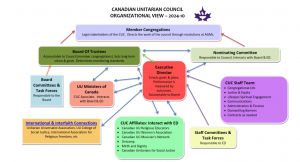
In addition, the CUC has relationships with UU communities, considered “moral owners,” which include UU youth, young adults, ministers, religious educators, lay chaplains, social responsibility groups, and associate members.
Board of Trustees
The Council, represented by delegates from member congregations, elects regional representatives to a Board of Trustees at the Annual General Meeting each May.
- Board Policy Manual (pdf)
- Board Covenant (pdf) (2023)
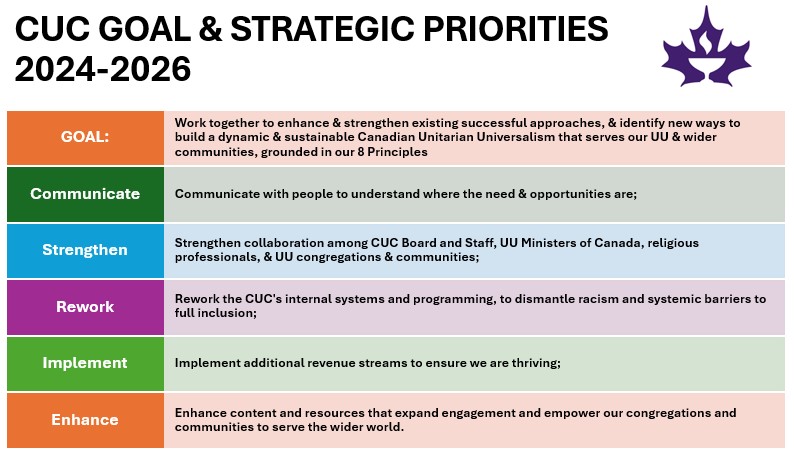
Strategic Priorities and Goals
Strategic Priorities are approved annually at the Annual General Meeting. Each year the CUC Board of Trustees reviews the goals against needs and what has been accomplished.
Affiliate Relationships
Affiliates are organizations which have principles or beliefs comparable to those of the CUC, and which engage in similar goals and activities. The CUC and each Affiliate enter into a mutual relationship guided by a covenant.
CUC Staff
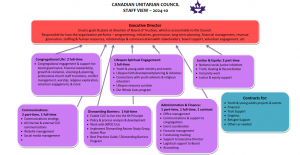
The CUC Board appoints an Executive Director (ED) who is the Chief Executive Officer of the organization. The Executive Director hires staff and recruits volunteers in order to undertake the tasks of the CUC.
Nominating Committee
The CUC’s Nominating Committee is responsible for identifying and nominating prospective members of the CUC Board.
Task Forces, Study Groups, and Committees
From time to time, the Board may establish a task force or an ad hoc or on-going committee to help it do its job. The Council, by vote of the delegates at an AGM, may also establish a Task Force or Study Group to examine a particular subject.